


The Society of Motion Picture and Television Engineers (SMPTE), the international professional organization that shapes technical standards for the motion picture, television, and digital media industries, has announced a major breakthrough. The organization has made its entire catalog of standards and technical documents completely free of charge. For engineers and specialists, this marks the end of paying hundreds of dollars for access to the core documents that define modern broadcasting. Whether you need detailed specifications for SDI interfaces, IP transport under the ST 2110 standard, or the exact definition of seamless redundancy in ST 2022-7, all of these crucial documents are now available at no cost and with absolutely no registration required.
What is Included in the Free Access?
The organization has opened up its complete catalog, which includes more than 800 active Standards (ST), Recommended Practices (RP), Engineering Guidelines (EG), and Registered Disclosure Documents (RDD).
Here is a selection of the most significant standards that have fundamentally shaped, and continue to shape, the broadcast landscape:
- ST 259 (SDI): The standard that ended the era of manufacturers' proprietary interfaces and defined the first unified digital interface for video signal transport.
- ST 292 (HD-SDI): A milestone that paved the way for television stations and production houses to distribute and process high-definition (HD) content.
- ST 2022 Series: The first comprehensive framework for transporting professional video and audio over IP networks (specifically covering MPEG-2 transport streams over IP and the first generation of uncompressed video).
- ST 2059: The standard defining signal synchronization via PTP (Precision Time Protocol / IEEE 1588). In modern facilities, this eliminates the need for deploying traditional analog synchronization signals like Black Burst or Tri-Level Sync.
- ST 2110 Series: The biggest technological revolution of recent years. This suite of standards defines the transport of uncompressed video over IP networks, with its primary benefit being the strict separation of video, audio, and metadata into independent, individual IP streams.
These and hundreds of other highly specialized documents are now just a few clicks away for every engineer—completely free of charge and without restrictions.
 Lukas Marek
Why Did SMPTE Make This Move?
This strategic shift has one primary goal: to significantly accelerate the real-world adoption and implementation of these standards. By opening access to software developers, system integrators, academia, and manufacturers alike, the risk of misinterpreting the specifications is dramatically reduced. Everyone now has the opportunity to pull information directly from the ultimate and official source of truth.
SMPTE leadership is fully aware that modern video infrastructure is massively shifting toward software-defined environments, the cloud, and open-source projects. If the new generation of engineers and developers is to build their solutions on proven industry standards—rather than inventing their own proprietary protocols—removing the financial barrier was absolutely essential.
This shift in the business model is driven by the so-called "Diamond Partners," whose financial contributions and grants made it possible to open the entire catalog to the public for free. These key supporters include technology and media giants such as: Amazon Web Services (AWS), Apple, Blackmagic Design, Paramount Global / CBS, The Walt Disney Company, Dolby Laboratories, Fox Corporation, Google, Ross Video, Sony Corporation, Telstra
Why is Access to the Original Standards Critical?
If you operate in the broadcast or media industries as a technician, engineer, or software developer, direct access to these documents is practically a necessity. They represent the absolute and unquestionable source of truth. Most secondary materials available online are merely simplified interpretations, which can often carry the authors' subjective viewpoints or unintentional technical inaccuracies.
On the other hand, it is fair to admit that studying SMPTE standards is no walk in the park. These are extremely detailed, formal, and technically dense texts. They require a deep understanding of the subject matter and the ability to read specifications down to the individual bits and structures. Despite this steep learning curve, having the official documentation at your fingertips provides a massive advantage when debugging complex systems or designing next-generation video infrastructure.
How to Get SMPTE Standards Like ST 2110, ST 2022-7, or MXF Specifications For Free?
Navigating your way to the complete SMPTE catalog is completely straightforward and does not require filling out any registration forms.
Just follow these steps:
- Visit the official website at SMPTE.org.
- In the main menu, click on the Free Standards section and then select Access Standards Library.
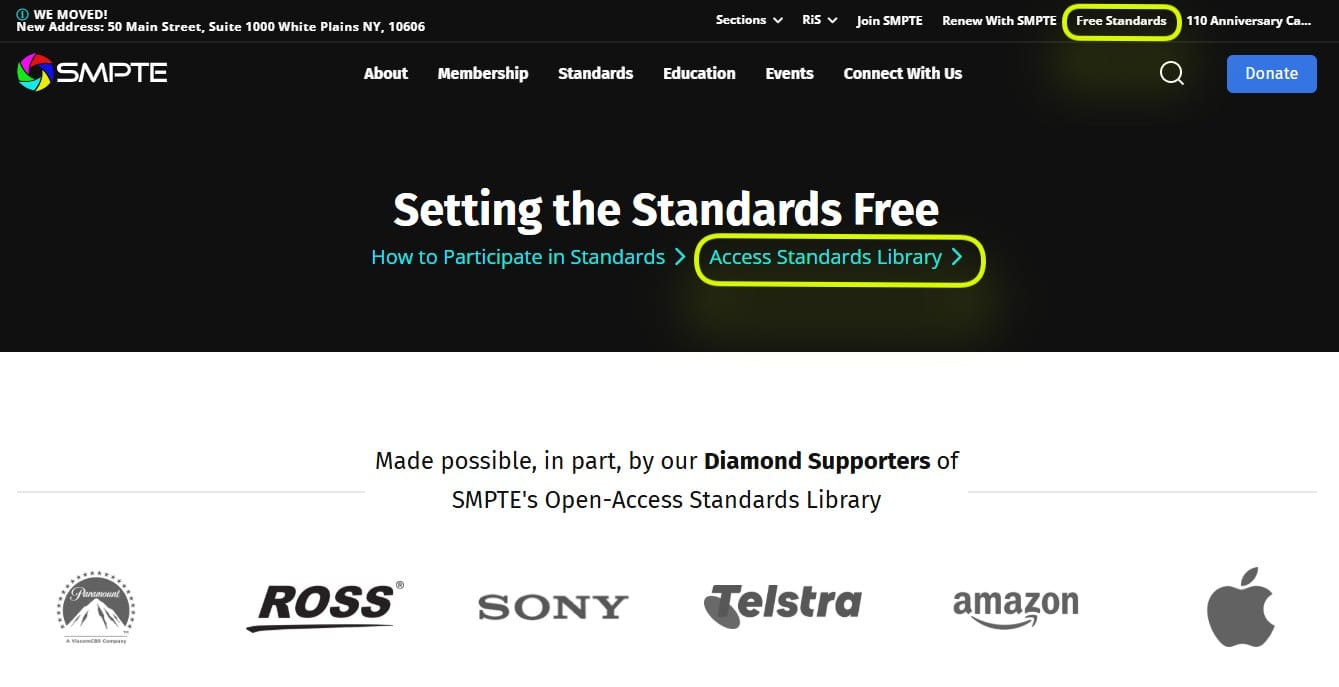
- The system will redirect you to the SMPTE Document Library interface, which features a search engine and a complete list of all published standards.
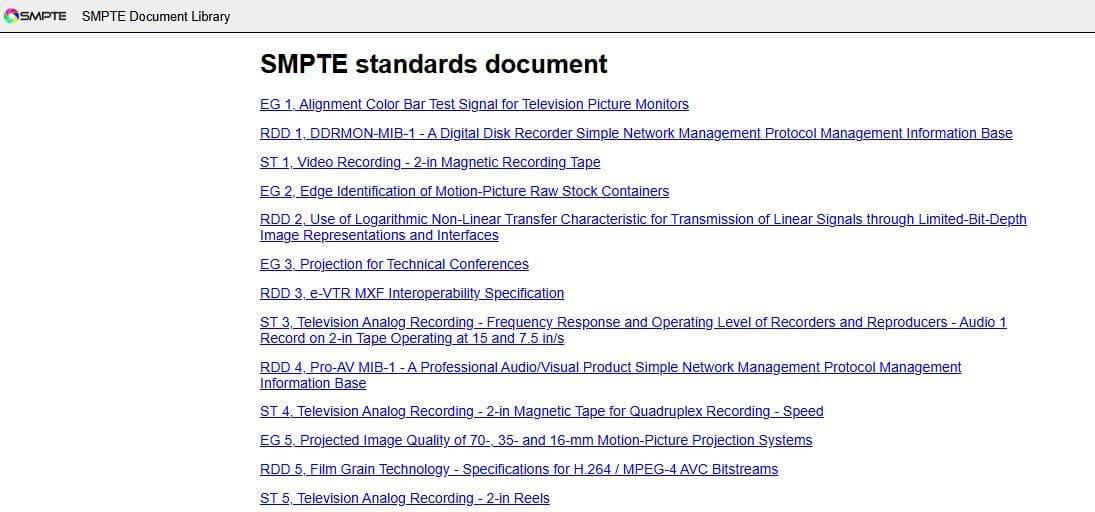
- Search for your desired document (e.g., ST 2110-20), open the relevant edition, and the full text along with all graphical specifications will be displayed instantly.
Additionally, you can download the entire document as a PDF directly from your browser for offline study or archiving.
You can download the ST 2110 specification directly here:
Conclusion
Founded in the USA back in 1916, SMPTE now serves as the technological backbone of the entire industry. Its standards are implemented by virtually every major manufacturer of broadcast equipment—ranging from studio cameras, routing switchers, and production switchers to playout servers, graphics systems, and software tools.
In day-to-day broadcast operations, we encounter these standards at every turn, whether dealing with legacy distribution via SDI interfaces or modern IP transport built upon the ST 2110 suite.
By unlocking its entire catalog, SMPTE has dismantled a critical financial barrier that historically slowed down rapid integration and favored the rise of closed, proprietary systems. This move introduces maximum transparency into the entire development lifecycle, offering the broadcast community a unique opportunity for true unification as next-generation technologies are deployed.