


Video and audio transport technology in professional broadcast environments has undergone a fundamental transformation in recent years. For decades, the backbone of the television industry has been the reliable SDI (Serial Digital Interface) standard. However, this proven system is reaching its limits and can no longer meet the demanding requirements of modern television studios, international sports broadcasts, and large-scale live productions such as major music festivals.
The television industry is increasingly turning to IP-based solutions, which offer greater flexibility, scalability, and efficiency. One of the key technologies in this area is the relatively new ST 2110 standard, designed for the universal IP transport of video, audio, and ancillary data. Below, we will examine the main differences between SDI and ST 2110, and in which scenarios SDI still makes sense, as well as when the transition to ST 2110 clearly provides advantages.
SDI – The Foundation of Broadcast Infrastructure for Several Decades
The first version of the SDI standard was defined in the late 1980s. The standard was developed by SMPTE (Society of Motion Picture and Television Engineers), an organization focused on standardizing technologies in the film and television industry. The main motivation behind SDI was the transition from analog to digital signal processing, which required a universal standard ensuring compatibility between different devices such as cameras, monitors, routing switchers, broadcast servers, and playout systems from various manufacturers. In addition, strong emphasis was placed on maintaining the highest possible signal quality.
The SDI standard fulfilled all of these requirements. Its main advantages include high reliability, simplicity, broad cross-vendor compatibility, and low latency. Another important characteristic is its ease of installation, which significantly reduces the time required for troubleshooting and system deployment.
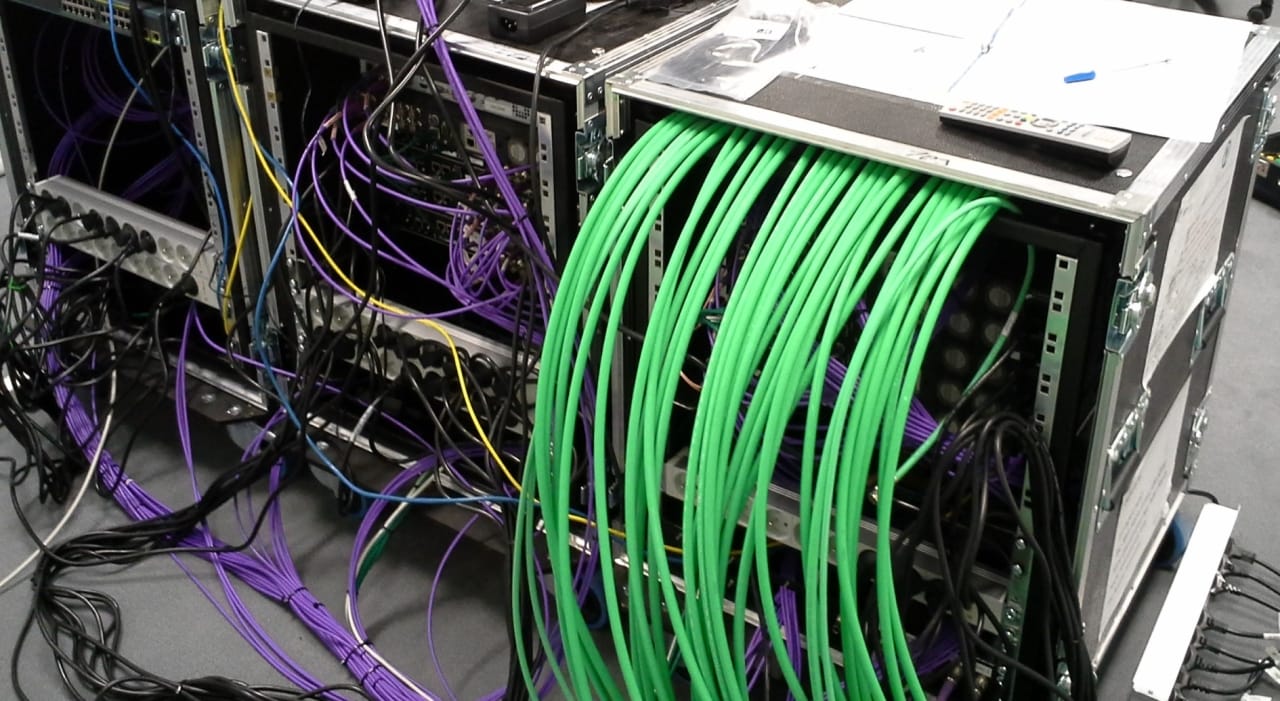
In an SDI system, the signal typically flows in one direction—from point A to point B. In more complex configurations, the signal passes through several active devices or is distributed using distribution amplifiers (DAs) or SDI routing switchers. This serial transmission, where only a single video signal (or an embedded signal containing audio and ancillary data) is carried over the physical transmission medium (coaxial cable or optical fiber), significantly simplifies the work of broadcast technicians and engineers—even despite the well-known “spaghetti” wiring setup, where one must navigate a dense maze of coaxial cables.
Over the years, the SDI standard has evolved, and several versions now exist. The most significant ones are as follows:
SMPTE 259M (SD-SDI) The first SDI standard, introduced in 1989, enabled the transmission of standard-definition (SD) video signals (720 × 576 pixels). The most common data rate was 270 Mbps, which was well suited to the television production requirements of that time.
SMPTE 292M (HD-SDI) With the advent of high-definition television in 1998, the HD-SDI standard was developed, enabling transmission in 720p and 1080i formats. This standard provided a significantly higher data rate of 1.485 Gbps, meeting the requirements for high-quality HD video transport.
SMPTE 424M (3G-SDI) Introduced in 2006, the 3G-SDI standard enabled the transmission of 1080p signals at 50 or 60 frames per second. It supports a data rate of 2.97 Gbps.
SMPTE ST 2082 (12G-SDI) Released in 2015, 12G-SDI was introduced in response to the growing demand for UHD 4K transmission (3840 × 2160 pixels). This standard allows 4K video at 60 frames per second (fps) over a single link with a data rate of 11.88 Gbps.
SMPTE ST 2083 (24G-SDI) Introduced in 2020, 24G-SDI enables the transmission of UHD 8K signals (7680 × 4320 pixels) at 60 frames per second, with a maximum data rate of 23.76 Gbps. However, 8K transport is more commonly implemented using Quad-Link 12G-SDI, a technology that combines four parallel 12G-SDI signals. This approach was developed for 8K content before the introduction of 24G-SDI, which instead enables single-cable transmission.
Although SDI remains a proven standard with many advantages such as reliability, low latency, and ease of implementation, its limitations—such as restricted coaxial cable length, complex infrastructure for 8K installations, and high costs for long-distance transmission—are gradually reducing its usage. In environments where high flexibility and scalability are required, SDI is already reaching its limits. This is precisely where modern IP-based solutions and the ST 2110 standard come into play.
SMPTE ST 2110: The Future of Video Transport
With the growing need for more efficient and flexible content distribution in the television industry, a new standard for IP-based media transport was developed—ST 2110. Developed by SMPTE and first introduced in 2017, this standard brings significant technological improvements over its predecessor, SDI. Like SDI, it is designed for professional audiovisual transport, but it enables operation within modern IP environments.
ST 2110 allows the transmission of uncompressed video over standard Ethernet networks at 10 Gbps and above, providing greater flexibility, scalability, and efficiency for modern television production workflows. The standard is divided into four key parts, each defining requirements for timing and synchronization, video, audio, and ancillary data.
ST 2110-10: System Requirements
This part of the standard defines the fundamental rules for correct interoperability between individual system components. A key element is synchronization using PTP (Precision Time Protocol), which enables highly precise timing between video, audio, and ancillary data streams. Unlike conventional NTP (Network Time Protocol), which provides synchronization accuracy in the millisecond range, PTP offers precision in the microsecond to nanosecond range. This level of accuracy is essential in applications where perfect alignment of individual streams is required, such as live broadcasting or studio production.
ST 2110-20: Uncompressed Video Transport
This section of the standard defines the transport of uncompressed video. The signal is not degraded by compression, ensuring high image quality and minimal latency. Unlike SDI or IP transport based on the ST 2022-6 standard, ST 2110-20 offers a key advantage. It carries only the active picture area and does not include blanking intervals or inactive portions of the video signal. This approach optimizes bandwidth usage, resulting in savings of up to 30% compared to traditional SDI transmission.
ST 2110-30: Uncompressed Audio Transport
ST 2110-30 is the part of the ST 2110 standard focused on the transport of uncompressed PCM audio, based on the AES67 protocol with which it is fully compatible.
ST 2110-40: Ancillary Data Transport
ST 2110-40 focuses on the transport of ancillary data (ANC data), which may include timecodes, subtitles, camera and production metadata, as well as other control and synchronization information. In traditional SDI systems, this data is typically embedded within the inactive portions of the signal, whereas in ST 2110 it is carried as a separate stream, simplifying management and increasing flexibility.
In addition to the sections mentioned above, the ST 2110 standard also includes specifications for compressed media transport and extends these core standards. Notably, ST 2110-22 defines the transport of compressed video over IP networks. This standard enables efficient video compression, reducing bandwidth requirements without a significant loss in image quality. This is ideal for installations where uncompressed video would be challenging in terms of bandwidth, such as high-resolution workflows or long-distance transmission. Supported compression formats such as JPEG XS are widely used due to their very low latency and high image quality.
 Lukas Marek
The Main Advantage of ST 2110
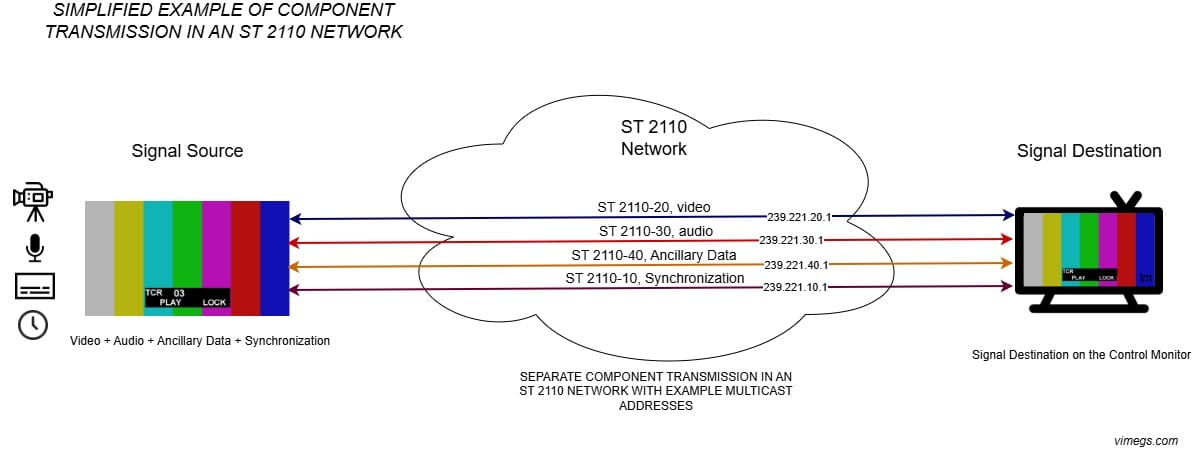
From the core components of the ST 2110 suite—ST 2110-10, -20, -30, and -40—one fundamental advantage becomes clear: video, audio, and ancillary data are transported separately using unicast or multicast addressing. This represents a major shift in the approach to media distribution.
In an SDI-based workflow, if video, audio, and ancillary data are to be carried over a single physical medium simultaneously, they must be embedded into one signal. This process requires additional active devices in the signal chain, increasing system complexity and the likelihood of errors. A similar approach is used in ST 2022-6, which encapsulates the entire SDI signal—including embedded components—into IP transport using a single unicast or multicast stream.
Thanks to its essence of elementary stream separation, ST 2110 becomes significantly more flexible and scalable. It enables efficient management of large data flows and network resources within the infrastructure. The network design is simplified, as there is no longer a need for complex SDI routing switchers, embedders, or de-embedders. For example, if only the audio signal needs to be delivered to an audio control room or audio production suite, there is no need to transport the full video stream, which saves bandwidth. This approach also enables more cost-efficient network planning, as lower-bandwidth switches can be used for audio-only transport.
Another advantage is flexibility in content distribution. During international sports events, individual television or radio broadcasters can receive video feeds with different language versions. The system allows precise control over which audio components are delivered to each broadcaster. For radio stations, the video component can be easily filtered out entirely, significantly reducing bandwidth usage.
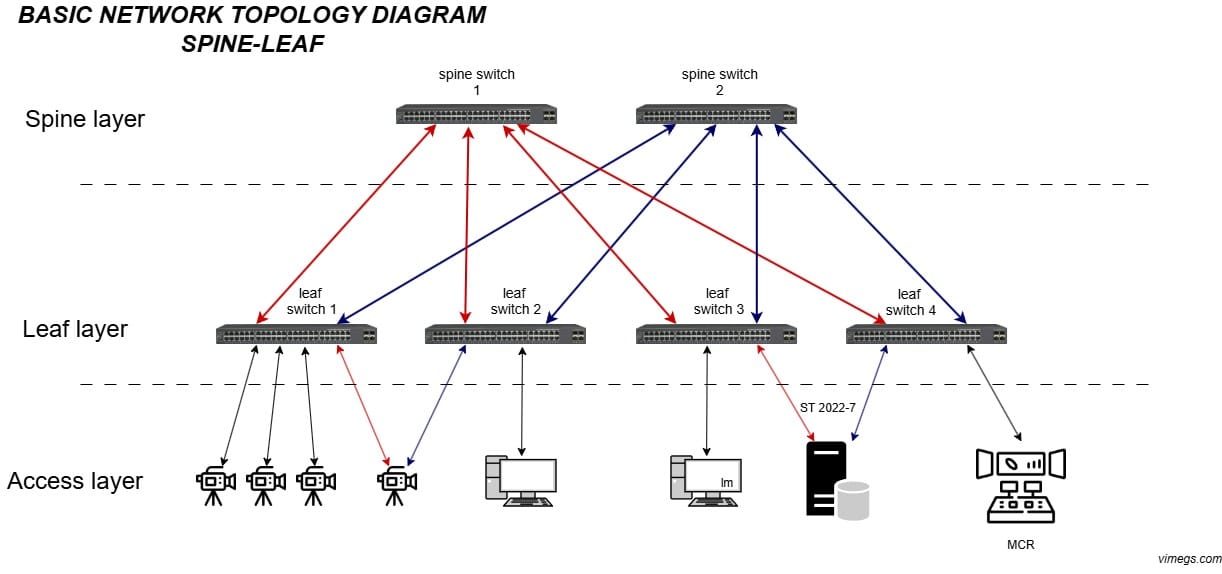
ST 2110 Network Topology – Redundant Spine/Leaf
Thanks to its network architecture, solutions based on the ST 2110 standard are highly scalable and allow easy integration of new devices such as cameras, control rooms, studios, monitoring rooms, playout servers, encoders, decoders, and other servers, without requiring complex infrastructure changes.
Signals are efficiently distributed using multicast, enabling data to be transmitted from a single source to multiple destinations without the need to duplicate the stream for each receiver. This approach significantly reduces cabling requirements, which not only simplifies technical implementation but also results in cost savings.
The ST 2110 standard predominantly uses a redundant spine/leaf topology. Spine switches form the core of the network, while leaf switches are used to connect end devices such as cameras and the other technologies mentioned above. A basic configuration of this topology consists of two core (spine) switches and multiple edge (leaf) switches. The leaf switches are connected to the core switches via separate networks, commonly referred to as Red and Blue. This 1+1 model provides two fully independent networks, ensuring high reliability and resilience.
To achieve maximum system reliability, the 1+1 model implements the ST 2022-7 protocol. This allows simultaneous transmission of identical signals over two completely independent paths. If one path fails, the other continues transmitting without any interruption. Receiving devices that support ST 2022-7 receive data from both paths simultaneously and continuously compare the two streams. In the event of packet loss or failure on one path, the device seamlessly switches to the intact data from the other path.
Software-Defined Networks
Another technology frequently used in ST 2110 installations is Software-Defined Networking (SDN). SDN represents a modern approach to network design, management, and operation, where the key innovation is the separation of the control plane from the data plane.
The data plane is responsible for the actual transmission of data between network devices, i.e., packet forwarding, while the control plane is responsible for decision-making regarding data flows—determining how and where data is transmitted. This concept enables centralized network management through software applications. From a single central location, it is possible to monitor the entire network, update routing tables and device rules, observe network load, and implement changes in real time.
The advantages of SDN include:
- Greater flexibility – easier adaptation of the network to current requirements
- Faster implementation of changes – updates can be applied instantly and efficiently
- Network programmability – enabling automation and programmability of network functions
All of these key characteristics make SDN an ideal fit for modern television systems based on the ST 2110 standard.
When to Use Proven SDI Solutions and When to Transition to Modern ST 2110
The advantages of the ST 2110 standard are undeniable, but reliable and fundamentally simple SDI-based solutions will continue to dominate the television industry for some time. Television broadcasters currently have limited motivation to replace their existing SDI infrastructure with new solutions, mainly due to the high costs of a complete infrastructure overhaul and the need to retrain staff.
Although so-called hybrid solutions can be used—where newly acquired ST 2110-capable devices are integrated into existing SDI systems via gateways—the full potential of the new standard is not realized in such setups. Another challenge is the growing demand for new skills and competencies among broadcast engineers and technicians. With the transition to IP technologies, demand will increase for multidisciplinary professionals who combine expertise in broadcast television systems, IP networking, and IT. Those who adapt to this new ecosystem will become key players in the media and broadcasting industry.
However, ST 2110 deployment makes perfect sense in greenfield projects, such as newly built studios and television stations, as well as in environments where high flexibility and scalability are required. Typical examples include the Olympic Games, the FIFA World Cup, other major football broadcasts, concerts, remote production workflows, and multi-platform content distribution.
There is no doubt that the ST 2110 standard will eventually replace traditional SDI in television production. Successful deployments of this technology at the world’s largest sports events demonstrate that the future of broadcasting is clearly IP-based. Cloud processing, the ST 2110 standard, and transport protocols such as SRT will gradually form a unified ecosystem that replaces traditional hardware-based infrastructure.