



Do you need to transport a live feed from a sports venue to the television station's headquarters? Do you need to deliver a linear TV channel from the studio to a distribution network? Or perhaps send a remote camera feed halfway across the world straight into the master control room? If so, and you are wondering how to achieve this easily, reliably, securely, and most importantly cost-effectively, rest assured that such a solution exists.
For live sports contribution back to the broadcaster's headquarters, satellite capacity is still widely used today. The main output from the production truck is fed into an SNG (Satellite News Gathering) van, and from there, beamed via satellite directly to the TV station’s reception hub. The second established alternative is using IP transport over dedicated fiber-optic lines. Whether it is distributing a finished TV channel to a broadcast network or video feeds from individual cameras, the approach remains very similar.
While satellite distribution can be considered time-tested and reliable, the costs associated with such transmissions are exceptionally high. Furthermore, the equipment inside SNG vans is highly specialized and expensive. Rranging from modulators and HPA (High-Power Amplifiers) to automated satellite tracking systems. Fiber-optic routes, where the provider guarantees maximum stability and uptime, can be equally demanding on the budget.
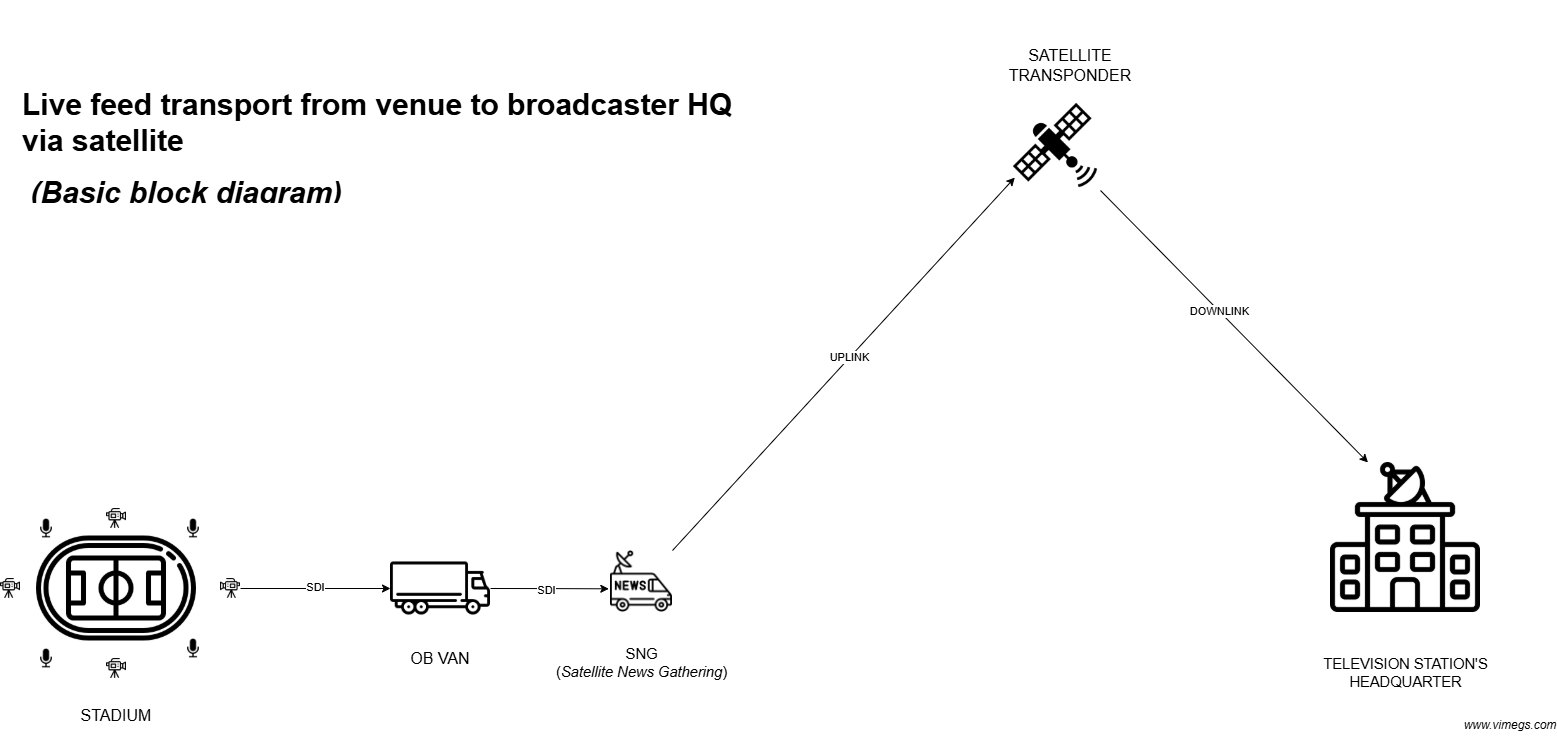
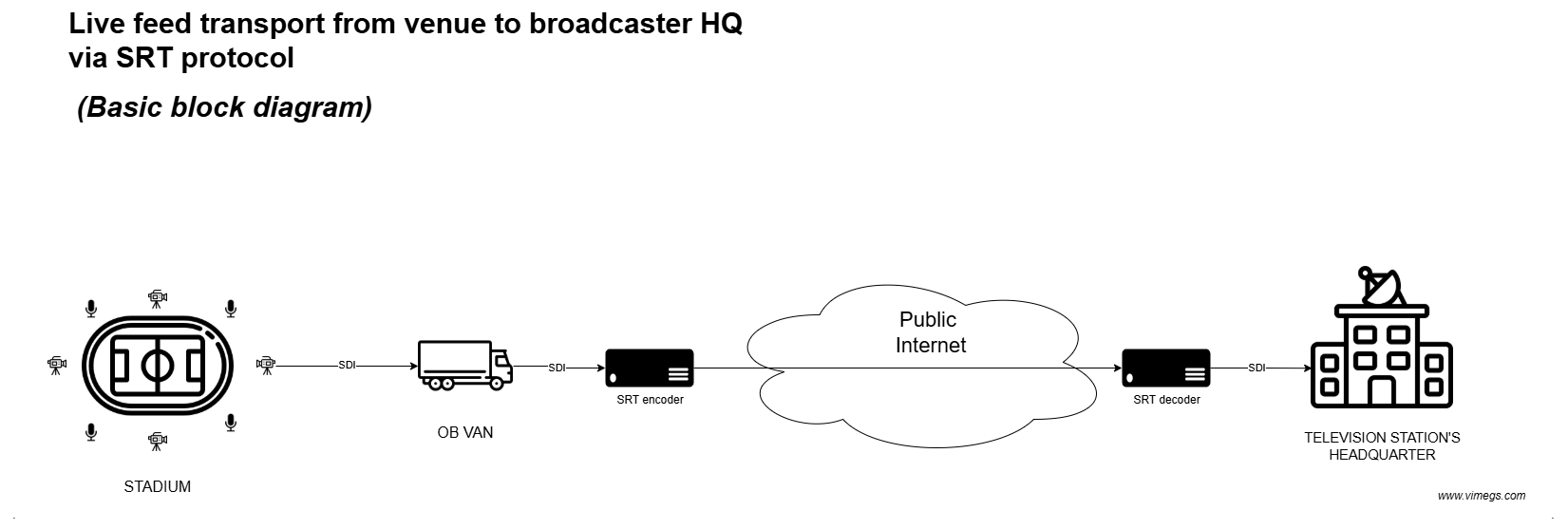
How then can we contribute and transport a television signal differently? And of course, ideally securely, reliably, and cost-effectively? The solution is transmission over the public internet.
If you are wondering how to reliably transport a relatively high-bitrate video signal over a network that is inherently unreliable, such as the internet, the answer lies in choosing the right transport protocol. This protocol is called SRT (Secure Reliable Transport).
Why is SRT So Ingenious and the Ideal Choice for You?
Using SRT, you can reliably transport a video signal including all audio components and metadata over an unreliable network. But what exactly do we mean by an "unreliable network"? It is typically the public internet, where it is simply impossible to guarantee the stability and consistency of basic transmission parameters. We are talking about fluctuations in available bandwidth, packet loss, bit errors, jitter, or variable latency.
The SRT protocol was designed from the ground up to eliminate these exact pitfalls of the internet. Its goal is to ensure a highly secure, reliable, and low-latency point-to-point transport that you can depend on.
What is SRT?
Broadly speaking, SRT is a technology that enables video transmission in the highest possible quality despite the aforementioned challenges of the public internet. However, the main asset of this protocol is its open-source nature. This is not a proprietary solution locked under an expensive license from a single specific vendor, but an open-source codebase available to the entire industry.
Today, the world's leading technology companies contribute to its development and integration. Within the alliance, we can find giants such as Haivision, Microsoft, AWS, Sony, Harmonic, ATEME, Grass Valley, EVS, NetInsight, Matrox, AJA, and hundreds of others. In total, more than 450 companies are currently involved in shaping this standard, which guarantees massive compatibility across the entire market.
A Look into the History of SRT
The protocol was originally developed by the Canadian company Haivision and first introduced to the public at the IBC show in 2013. However, the real breakthrough and revolution in broadcasting did not occur until 2017, when Haivision made a pivotal decision. To release the source code as an open-source project and found the SRT Alliance.
This strategic move triggered a landslide adoption across both the television and streaming industries. Within a few short years, SRT became a de facto industry standard and an absolute necessity for any modern video infrastructure.
Why is SRT So Popular in the World of IP Transport?
As previously mentioned, the massive adoption of the SRT protocol was primarily driven by its open-source nature and vendor independence. Consequently, it has gained widespread support from television broadcasters, OTT platforms, hardware manufacturers, and cloud service providers. While this alone forms a strong foundation for its success, its true popularity is driven by the following core technological pillars:
- Low Latency: Live video transmission delays typically drop well below the 1-second mark, making SRT an ideal choice for interactive live broadcasting. For comparison, the HLS (HTTP Live Streaming) protocol, which is standard for traditional OTT streaming and VOD (Video on Demand), commonly suffers from a latency of 6 to 30 seconds.
- High Reliability: Utilizing an ARQ (Automatic Repeat reQuest) mechanism, which automatically requests and retransmits lost packets. SRT effectively eliminates dropouts and jitter. This results in a completely stable feed, even when network conditions fluctuate or experience severe packet loss.
- Uncompromising Image Quality: SRT is content-agnostic, supporting a wide range of video formats, resolutions, and codecs. It most commonly transports streams encoded in H.264 (AVC), H.265 (HEVC), or professional formats such as JPEG-XS and JPEG2000. With native support for resolutions up to 8K and high bitrates (easily exceeding 50 Mbps), it serves as a truly universal transport solution.
- Advanced Security: Unlike legacy protocols (such as RTMP), SRT offers robust security directly at the transport layer. The entire stream can be encrypted using AES-128 or AES-256 standards, reliably protecting premium content from eavesdropping and unauthorized interception. Furthermore, the protocol features built-in mechanisms that facilitate easy firewall traversal and defend against DoS (Denial of Service) attacks.
- Efficient Bandwidth Utilization: SRT minimizes network overhead. Unlike standard TCP, which halts the entire transmission when a packet is lost, SRT delivers data continuously and reacts in real time. It operates reliably even on bandwidth-constrained links, working closely with encoders to optimize data flow based on current network conditions.
From Low-Cost Streams to Massive Distribution
The SRT protocol has long outgrown its status as just a tech toy for enthusiasts. While in its early years it was seen primarily as an affordable alternative for low-budget projects, used by local TV stations, internet streamers, or smaller production agencies, the landscape today is entirely different.
Based on my own extensive experience in television infrastructure and broadcast headends, I can confirm that SRT has become a mainstream technology in professional broadcasting. Today, tier-1 operators, multinational TV networks, and global sports organizations increasingly rely on this protocol. They view it as a fully-fledged, flexible, and extremely cost-effective alternative to traditional satellite delivery and expensive dedicated IP circuits.
SRT in Action: From the Olympic Games to the FIFA World Cup
The ultimate proof of this technological shift is the deployment of SRT at the planet's largest sporting events. A prime example is the Olympic Games. Today, Media Rights Holders can choose whether to ingest primary feeds via traditional satellite or through SRT.
The recent Olympic Games in Paris are a testament to how drastically the landscape has changed. There, for the first time in history, more broadcasters and television networks utilized SRT-based distribution than traditional satellite routes. SRT simply offers unprecedented flexibility. Thanks to this, the host broadcaster OBS (Olympic Broadcasting Services) can efficiently distribute not only all main program feeds but also a massive volume of ancillary and supplementary signals, which would be economically unfeasible over satellite.
And it will be no different at the upcoming FIFA World Cup. The host broadcasting organization HBS (Host Broadcast Services) will offer the option to ingest feeds via the SRT protocol as a fully-fledged alternative alongside standard satellite capacity.
SRT Opens New Horizons
Thanks to the SRT protocol, entirely new possibilities are opening up for working efficiently and flexibly with video content distribution. For end-users and viewers, the ultimate result is simple: production teams can now offer much more diverse, high-quality content and broadcast events that previously would not have made economic sense due to the astronomical costs of satellite or fiber optics.
The scope of SRT applications today is immense. It finds its place in everything from low-cost local productions to the largest multinational sporting events on the planet. Whether it involves the primary transport of a live feed from a venue to a master control room, the distribution of linear TV channels to satellite, cable, and OTT headends (for subsequent broadcasting across DVB-T2, DVB-S2, or IP networks), or the reliable transmission of standalone audio tracks—such as remote commentary from a stadium—SRT proves that it is rightfully considered the future of television and internet transmission.