



Let me start with a tricky question. To be, or not to be at the stadium during the FIFA World Cup? Would you rather watch a football match live in the stadium, or from the comfort of your home? At the stadium, you experience the electrifying atmosphere, the emotions of the fans, and the unforgettable feeling of being part of the action. But what about a television broadcast? Can it truly replace the stadium experience?
I dare say that today’s football broadcasts and production quality have reached such a high level that they can transfer the stadium atmosphere to television screens with remarkable authenticity. When high-quality commentary, sophisticated graphics, real-time statistics, immersive audio, and, above all, ultra-high-definition match coverage come together, the result is an experience that comes surprisingly close to actually being there.
In this article, I want to focus primarily on the cameras that pull us directly into the center of the action. We will take a closer look at their purpose, their different types, and explain the importance of the camera plan.
The FIFA World Cup 2026, hosted for the first time in history by three countries, the United States, Canada, and Mexico, will push visual production to unprecedented levels. The technical parameters of the broadcast are set to the highest possible industry standards:
- UHD/HDR and High Frame Rate: The main production feed and selected standard cameras will capture footage natively in UHD (Ultra High Definition) resolution with High Dynamic Range (HDR) at 50 frames per second (fps). This format ensures exceptional sharpness, smooth motion, and accurate color reproduction even under challenging lighting conditions, such as transitions between shadows and direct sunlight on the pitch.
- Super and Ultra Slow Motion: Cameras dedicated to slow-motion replays (Super and Ultra Motion) will operate in 1080p resolution at frame rates of 150 fps and higher, with Ultra Motion systems reaching thousands of frames per second. This enables highly detailed analysis of critical fouls, ball trajectories, and even micro-expressions on the players’ faces.
- Format and Distribution: The primary master feed is produced in the widescreen 16:9 format. However, as we will discuss later, the digital era has forced the introduction of parallel crops and transformations that convert the traditional horizontal composition into vertical and interactive formats.
While FPV (First-Person View) drones and cameras became a technological sensation during the Winter Olympic Games, delivering breathtaking high-speed shots in alpine skiing, bobsleigh tracks, and speed skating arenas. The FIFA World Cup faces very different spatial and safety limitations, including strict federal, municipal, and stadium restrictions on free-flight operations.
Football broadcasting therefore does not simply imitate the Olympics. Instead, it introduces a highly sophisticated production scheme built around the deployment of up to 45 cameras for every single match. In total, the tournament will feature 104 matches, and FIFA guarantees that all 104 games will receive the same premium production standard. Top-tier technical coverage will not be reserved only for the semifinals and final. Every match, starting from the group stage, will benefit from world-class broadcast production.
Stadium Camera Typology – From Traditional Broadcast Systems to Analytical 3D Technology
The modern football stadium is filled with camera systems that can be divided into four fundamental categories based on their primary purpose, technological workflow, and signal distribution methods:
- Broadcast Cameras (Broadcast Systems): These cameras form the backbone of the entire production. They are professional television cameras designed for live broadcasting and permanently connected to the production control system. Optimized for long-duration live transmissions, they are equipped with lenses featuring massive optical zoom capabilities and are specifically adapted for dynamic sports coverage. Their primary role is to deliver a stable, perfectly focused, and color-balanced image for the main television feed.
- Cinematic Cameras (Cinematic Systems): These cameras are used to enhance the visual experience and create what is often referred to as “storytelling.” They utilize large-format sensors (Super 35mm or Full Frame) with shallow depth of field, delivering a cinematic look. The result is footage with beautifully blurred backgrounds (the bokeh effect), isolating players or coaches from the surrounding crowd and giving the broadcast the visual aesthetics of a Hollywood film.
- Streaming and Digital-First Cameras: A relatively new yet critically important category. These cameras are not designed primarily for traditional linear television. Instead, they are streaming-native, fully integrated into IP and cloud-based infrastructures, and generate content for social media platforms such as TikTok and YouTube, mobile applications, and interactive digital services. They often operate from unconventional angles and formats and include 360-degree systems, lightweight wireless cameras, and even player- or referee-mounted micro cameras.
- Telemetry and 3D Analytical Cameras: These systems operate in parallel with the television broadcast. They are typically fixed-position cameras, often running without direct human operation, controlled instead by advanced software and artificial intelligence. Their purpose is data collection. They continuously perform optical tracking of all players and the ball, generate telemetry data, power semi-automated offside detection systems, and provide the foundation for 3D visualizations, virtual graphics, and advanced real-time tactical analysis.
What Types of Broadcast Cameras Can Be Found Inside a Stadium?
When people hear the term “broadcast camera,” they often imagine a single large static camera positioned on the main stand. In reality, this segment is divided into several highly specialized subcategories, each playing an irreplaceable role in the structure of the match coverage:
- Main Match Coverage Cameras: Positioned on the main tribune directly along the halfway line (typically Camera 1 and Camera 2), these cameras provide the primary wide-angle overview of the tactical formations and follow the main flow of the game.
- In-Goal and Behind-Goal Cameras: Fixed or remotely controlled cameras integrated directly into the goal net or positioned immediately behind it, delivering uncompromising views of the goal line and shot trajectories.
- Reverse-Angle Cameras: Located on the opposite stand, these cameras provide alternative viewing angles, particularly useful for replay analysis of controversial situations.
- Steadicam Systems: Mobile camera operators equipped with mechanical or electro-mechanical stabilization rigs and support arms. They move along the sidelines to capture smooth eye-level footage during substitutions, medical interventions, and set-piece situations.
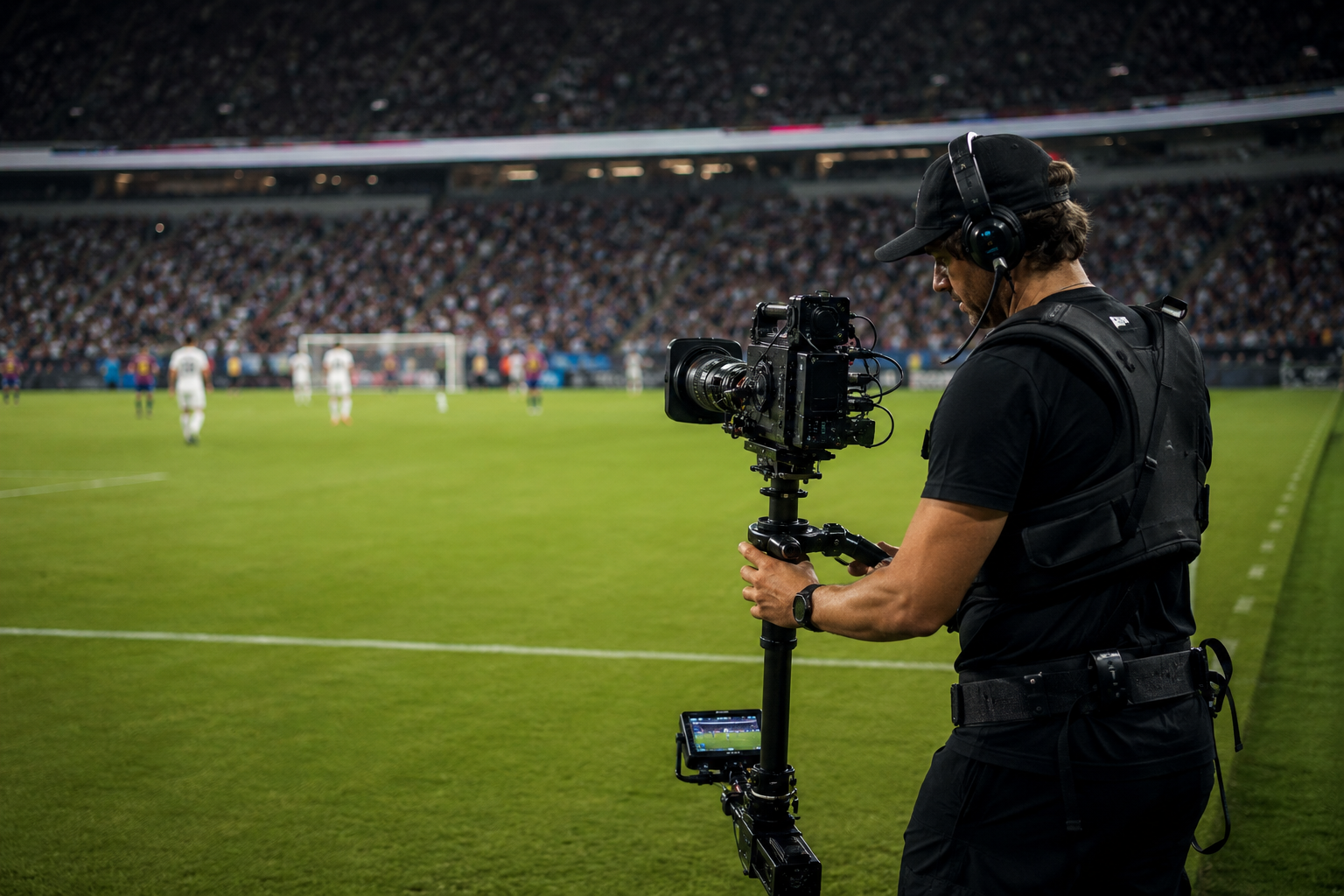
- RF Wireless Cameras: Cable-free cameras transmitting signals via radio frequencies. They allow operators to work inside stadium corridors, mixed zones, near team benches, or even among spectators in the stands.
- Pole Cam and Cablecam Systems: Specialized dynamic camera systems mounted on mechanical arms or suspended cables, representing the technological pinnacle of modern sports production.
What Is a Camera Plan and Why Is It Necessary?
The placement of cameras inside a stadium is anything but random. Every installation follows a document known as the camera plan. This plan represents the fundamental technical, logistical, and creative blueprint of the entire broadcast production. It is a detailed design that precisely defines the positioning, technical specifications, and exact role of every single camera system within the stadium.
No camera is placed in its position by accident, and no camera operator captures random shots. Everything is coordinated through a centralized plan approved by FIFA under the supervision of the host broadcasting organization (for example, HBS – Host Broadcast Services).
The camera plan defines four fundamental layers of production:
- Quantity and Typology: The exact number and type of deployed cameras (with a baseline of 45 cameras per match).
- Sector Positioning: The geometric positioning of camera locations throughout the stadium, including tribunes, pitch-level areas, elevated platforms, and roof-mounted positions.
- Capture Vector and Optical Range: The precise assignment of what each camera is expected to follow at any given moment — whether maintaining the overall tactical view, focusing on the left wing, delivering an isolated feed (ISO feed) of a celebrity in attendance, or capturing reactions from the team bench.
- Hierarchy Within the Production Chain: The way video signals are processed and integrated into the production workflow. In regular domestic league competitions, production teams usually operate with 8 to 20 cameras, limited by the technical capabilities of local outside broadcast trucks and the director’s ability to manage and cut between a smaller number of live signals in real time. A complex 45-camera setup requires extensive production infrastructure, including dedicated sub-control rooms for replay operations.
Geographical Distribution of Cameras Inside the Stadium
A typical premium FIFA camera setup relies heavily on the geometric symmetry of the stadium layout:
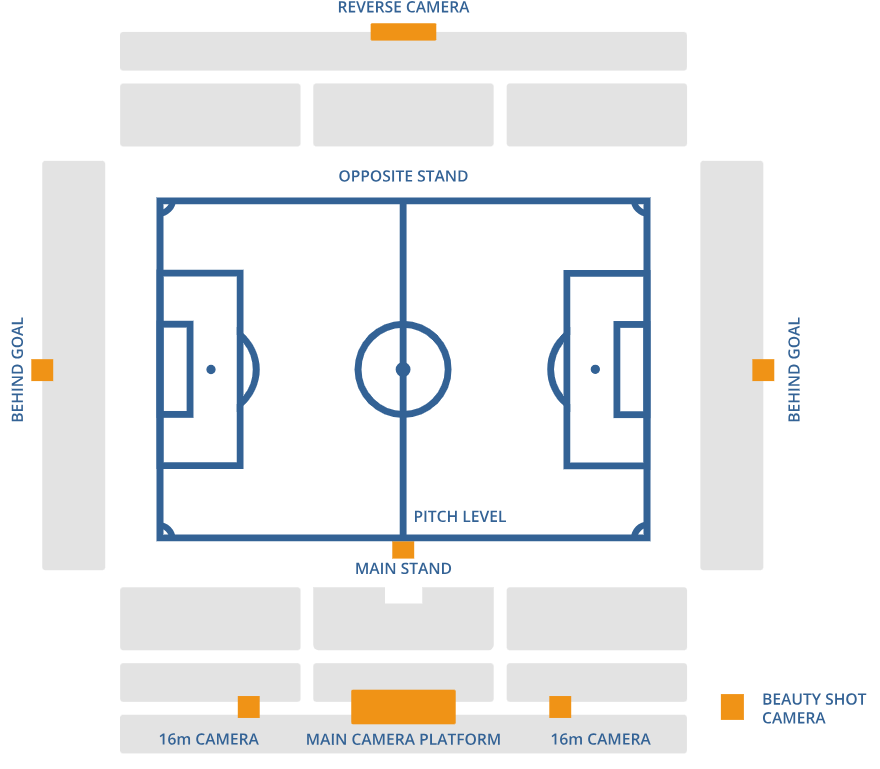
During the knockout stage of the tournament, this already massive camera plan becomes even more extensive. FIFA integrates additional Ultra Motion and super slow-motion systems while also expanding the portfolio of cinematic cameras.
The reason is largely psychological. As the importance of the matches increases, so does the need for dramatic storytelling. The audience no longer wants to simply see a foul — they want to see the sweat running down a player’s face, the vibration of a muscle upon impact, and the raw emotional reaction of victory or defeat captured in extreme detail.
Example – camera positions at the previous championship in Qatar
The End of Traditional Television Broadcasting and the Beginning of Multiplatform Content
The biggest leap in the production of the FIFA World Cup 2026 is the fact that broadcasting has definitively evolved beyond being just a traditional linear television feed designed for 16:9 screens. We now live in an era of fragmented attention spans and diversified distribution channels.
Modern audiences: especially younger generations no longer consume football matches as uninterrupted ninety-minute television events. Instead, they primarily engage with the most exciting moments of the game. They expect storytelling, emotions, statistics, interaction, comments, and shareable content.
Through digital-first cameras and advanced signal management, FIFA is therefore no longer creating a single unified television product. Instead, it is building a massive ecosystem of parallel formats and personalized content experiences.
Vertical Video and Social Media: Platforms such as TikTok, Instagram Reels, and YouTube Shorts require native 9:16 vertical formats. Traditional cropping from horizontal 16:9 footage often results in a loss of context, with players or even the ball disappearing from the frame. Selected lightweight cameras and AI-powered tracking systems therefore generate dedicated vertical compositions that automatically follow the center of the action and deliver near-live highlights optimized specifically for mobile interfaces.
Immersive Ecosystems and Virtual Reality: Thanks to the extensive deployment of 360-degree cameras and volumetric capture technologies, FIFA is also producing content for virtual reality (VR/360) environments and specialized mobile applications. Users equipped with VR headsets or smart applications can switch between different spherical viewpoints inside the stadium and experience the match as if they were standing directly above the team benches or behind the goal net.
IP and Cloud-Based Workflows: While traditional broadcast systems still rely heavily on SDI infrastructure and dedicated hardware routing, digital-first production systems operate natively on IP (Internet Protocol) and cloud-based architectures. Cameras transmit compressed data streams directly into digital networks, where automated AI-powered editing systems, global digital platforms, and marketing partners gain immediate access to the content.
This creates a completely individualized viewing experience. Fans can choose their own personalized perspective of the match directly within an application.
The FIFA World Cup 2026 clearly demonstrates that camera systems have reached a point where the technological boundary between reality, cinema, and video games is beginning to disappear entirely. The deployment of 45 state-of-the-art camera systems for each of the tournament’s 104 matches, all operating under a unified UHD/HDR production standard, pushes the limits of what the human eye can process during a sports broadcast.
So then. To be, or not to be at the stadium? :-)